Introduction to analysis of surface foreign matters
Foreign matters refer to substances mixed into raw materials or products other than the object articles.
In the production and use process, the product surface is often easy to be polluted, corroded, oxidized, or introduced and formed foreign matters due to production defects, negligence and other reasons, which increases the defective rate of products and has a great impact on the use performance of products. There are many reasons for the formation of foreign matters, such as impure raw materials, by-products of reaction, nonstandard process control or immature process formula.
In this project, the element and chemical composition contained in the foreign matter are obtained by analyzing the foreign matter, and the real cause of the foreign matter is found out based on the manufacturers understanding of the product and process. The foreign matter is avoided through the manufacturers improvement and adjustment of the formula and process.
This technology is specially designed for the analysis of small embedded foreign matters or surface contaminants and precipitates on products. For example, qualitative analysis of abnormal substances such as particles embedded or separated on the surface, small molecule migration, spots, oil like substances, mist like substances, rubber spray and so on is one of the most commonly used analysis methods to improve products in order to find pollution sources or incompatible formulations.
Analysis significance of surface foreign matters
① Quickly judge the composition of foreign matters or impurities, analyze the causes, rectify and improve the product yield;
② Improve the formula by analyzing abnormal substances;
③ Eliminate potential production hazards;
④ Ensure the stability of production.
Scope of application
It is widely used in chemical products, aviation products and their parts, automotive products and their parts, LCM series products, PCB&PCBA, electronic components and semiconductor products.
Analysis items of surface foreign matters
1. Analysis of organic foreign matters
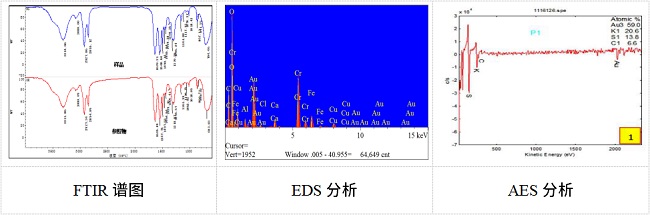
For the organic foreign matters on the surface of the product, according to the differences in the shape, detection depth and detection area of the foreign matters, a specific instrument is selected to analyze the organic components and determine the main components, so as to obtain the information of the foreign matters.
Organic foreign bodies are usually transparent and soft under magnification.
2. Inorganic foreign matter analysis
For the inorganic foreign matters on the surface of the product, a specific instrument is selected according to the difference in the shape, detection depth and detection area of the foreign matters to analyze the inorganic components, determine the element composition and content, and then analyze the composition.
Compared with the organic foreign matter, the inorganic foreign matter has a harder texture, deeper and more diversified color, and some of them have obvious crystal forms and are less transparent.
3. Analysis of unknown foreign matters
The comprehensive analysis is mainly conducted under the condition that it is difficult to identify the type of foreign matters, mainly combining the methods of organic foreign matter analysis and inorganic foreign matter analysis.
For example: embedded foreign matters or abnormal spots of electronic products; Surface pollutants, precipitates, oily substances and fogs; Rubber frosting; Yellowing and blackening of industrial products; Impurities and by-products of chemical products.
4. Comparison and analysis of product anomalies
The comparative analysis of product anomalies is to use the molecular atlas characteristics of materials to develop a rapid consistency detection method to determine the consistency of product materials, so as to analyze the causes of product anomalies.


 Current location:Home>Test Project>Analysis of foreign matters on the surface
Back
Current location:Home>Test Project>Analysis of foreign matters on the surface
Back